Our opening sequence illustrates quite a few conventions and signifiers of the thriller genre.
The opening sequence shows generic characters such as the femme fatal. Our sequence has themes of vulnerability, isolation,torture, crime,murder,entrapemnts, revenge, and death. The iconography wer have used includes an underground decaying room, a gun, pliers, and other torture weapons.
All togethor i think we have included enough conventions, and signifiers , so that the genre of the film is successfuly portayedto the audience.
Thursday, 24 January 2008

Independent Rupture Research
I also showed our film to family and friends who gave me some critics and postitives that they had .
" Really s@!t scared , very good, really like the titles" Wend Prince ( My aunt)
"Faaaaaabulous, but why is he tied up?" Anna Gavriliedes
" Edited well , and good creative effects in the titles, i'm unsre about the story though" Chris Welch
" The plot doesnt appeal to me, i wouldnt go and watch it, but the editing is good and the framing is nice. My favourite part is the blood titles. They are really thriller like" Janyn Williams .
"The titles and music are like a James Bond. I would give it 9 out of 10" James Devy
"WOW Max you guys are really amazing, it's really good. How did you do the blood titles and Black and White effect ? " Tamid Kuddus
"He must have been tied up for a long time , i want to see more" Rasheed
"cool" Owen Bradley ( he mumbled clearly enjoying the film)
" Sound quality for the speech lets it down a bit, but otherwise w good opening, very enigmatic and ends with an effective cliffhanger" Jake Moxon
Average mark i got out of 10 form friends and family was about 8.9 .
They think the area which we could most improve was the sound quality for speech.
Monday, 12 November 2007
Sin City
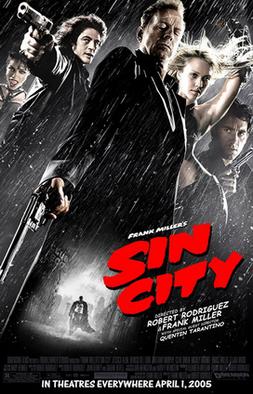


Sin City is a 2005 neo-noir anthology film written, produced and directed by Frank Miller and Robert Rodriguez. It is based on Miller's graphic novel series of the same name.
Sin City opened to wide critical and commercial success, gathering particular recognition for the film's unique coloring process, which rendered most of the film in black and white but retained coloring for select objects. The film was screened at the 2005 Cannes Film Festival in-competition and won the Technical Grand Prize for the film's "visual shaping."(wikipedia)
Sin City opened to wide critical and commercial success, gathering particular recognition for the film's unique coloring process, which rendered most of the film in black and white but retained coloring for select objects. The film was screened at the 2005 Cannes Film Festival in-competition and won the Technical Grand Prize for the film's "visual shaping."(wikipedia)
I looked at Sin City again , afer the black and white effect used in the Opening in Casino Royale inspired me to think of applying a similar effect in post production to our film. I think that Sin City is given such a dark and sinister tone through the black and white effect , with such bold high contrast and black and whites, it helps add meaning behind the narrative and connotes it to the auience extremely well. If using an effect like this in our thriller then i think for the film noir plot it will suit better if using higher contrast than casino royale. Especialy for an opening sequence this will impact more on the audience, so Sin City could be a big inspiration here.
Sunday, 11 November 2007
Resevoir Dogs
This is one of my favourite films. Now that we aare going with the tortue scene , and a chair , i have lookwed at this particular scene again.
I like how the villain toys with the victim, and he does not know what will happen next, then out comes the knife. I then like the toying with the victim, the fact that he knows what is about to happen, but the surel music and man dancing are not ready to hurt him yet.
I think in our torture scene if we were to toy with the tied up victim , either by shooting a blank at him, or laying out all the torture instruments in front of him, it would make our femme fatal seem even mmore sinister, and give the film an ever darker underlying tone.
Inspiration from Casino Royale
This is from the first scene to the new James Bond thriller Casino Royale. I have taken quite alot of inspiration from how this scene is lit, to the black and white effects that have been applied. This scene begins with a long establishing shot. I like how this sets out the location for the soon to happen events. I will hopefully use some longer shots at the beggining of my thriller opening to set out the location. The most effective part to this scene i think is how it is shot in black and white. This emphasises the dramtics of Bond killing in the bathroom. And makes it a clearly bold action, which impacts more on the audience. With my thriller it would be very interesting to experiment with a similar effect, as it would be simplistic and effective. The blacks that this creates are also a lot stronger , and add to the thriller signifiers Eg when bond is sat in the chair the dark shadow across half of his face are emphasised, linking to his dark side that has killed, for which we get flashes to. If i use black and white, then also making the contrast higher would improve the thriller appeal of my opening, and would help it look more proffessional rather than student film. I also think that the framing of close ups to the face, is inspiring, and will help me to follow the rule of 3 quarters.
Our group has been looking at doing a female revenge thriller. our discussions so far have led us into thinking of doing a torture scene, in an underground basement, with our male victim being tied up to a char and knoced out. I have lloked at this Casino Royale scene, as it is in my view brilliantly shot, and the mise en scene is extrmely effective. This sceneuses a great variety of shot distances, andgles and movement. All which make it interesting to watch. The low angles we have of Bond when he is thrown into the chair, show that he is still a strong character, despite being in such a desperate situation. Hinting he is not going to give in any secrets, and may escape. I like the low angles and framing, and when focusing on our male victim tied up it wuld be worth using varying angles including low. THere is one shit i particularly like, of the villain walking past the camera, which focuses ona closae up of his hand, panning to the left as he walks forwards to wards the chair. THis pan shot shows off the location ell, and brings the audiences attention to the rope in his hand, leaving us tense over what will happen next? What is the rope going to be used for ? . With our threiller, if using Emmas location. We could adopt this pan shot, and apply it to a different angle perhaps. we could have it from behing our victim as he is tied up, panning accros the room as the female killer paces around the room with a weapon.
I also really like the shot when the villain walks up to Bond, places the end of the rope on his shoulder, then bends down and speaks in to his ear. I think it shows a possible weakness of the viallin, as he is now sinking down to Bonds level of control over the situation. Signifying at what might come. I would like to use this in our film if we proceed with a female revenge thriller, as it would effectively play on the role reversal of power and sexuality between men and women.
There is another intuitive shot used here as well. From ground level through the chair legs. I like the framing in this shot, and we could use it to show our female role entering the scene, leaving her identity as enigmatic as possible for longer.
This scene is lit harshly over bond. With lack of light in a lot of areas. This makes us focus on Bond and the centre of the room, highlighting this action. We should consider this when lighing our location.
The mise en scene is also good. The central position of the chair, and the decaying, very underground urban look add to the theme of isolation. something we want to achieve in our thriller. This scene overall has inspired me withh shot types i want to use in our opening, and is also a good guide for our lighting and mise en scene.
I really like the titles for tyhis film . the graphics of them is really well done, and links in with the story perfectly. It is good inspiration to be more ambitous with our film titles. Like Running scared i like the graphic , and cartoon look of them. With our opening, although we will not have time to make anything like this, i would like to implement some form of titles that are not just the conventional text, on a blank screen , or superimposed ove rthe video. I think we could have blood splatters moving across screen, or sometihng like that. As if we go with revenge, and end it how we are currently thinking, then blood will be a goood signifier of the genre. And if going with black and white it would give our film an interesting colour scheme of black white and red. All generic colours to thriller . Hopefully i will be able to get some of the shot types, colouring effects, and titles to work with our film and improve it.
Wednesday, 7 November 2007
Dawn Of The Dead Opening Titles
Basic Plot Outline
In Dawn Of The Dead the world is hit by a strange plague that turns dead people into flesh-eating zombies. The zombies are out to kill everybody who is still alive. Once you are bitten, you die and return as a zombie. A group of survivors go to a shopping mall to find shelter. They begin to run out of food and then the lights go out. The survivors come up with a plan to escape to an island, but first they must get past thousands of zombies. They use the mall's shuttle busses to make their escape after the zombies break into the mall.
Opening Sequence
The first shot only flashes up on screen for less than a second. it is of a bloddy mouth. So immediately the audience is shocked and engaged with the danger. The first title of this opening sequence, is an animated graphic. It gives us the film name, which is in red, connoting to the audience blood and gore. The title then explodes like splattered blood. Setting up audience expectations for zombies, and blood spill.
The other titles are cut to be superimposed over the footage. So we focus on them. They are similar to the first title. Red in colour again connoting danger, violence and impeeding death, but instead of exploding the credits turn to blood which appears to drain away, perhaps hinting to the audience these characters die.
The camerawork in the opening is shot to create the same effect asd Danny Boyle in 28 days later. It is like a documentary, so making the audience feel mroe threatened and involved in the plot. It is really effective as you are instantly drawn in to the idea of the story, and plays on societies fears as a whole.
The ordinary on location settings, add to the way th efilm is shot as audiences can relate to the settings, as they are those of an every day town or city. Adding to the thrill the audience experierience as it is made more believable.
I think for my opening i will, use credits which are on screen by themselves cut between different parts of footage , as in Dawn Of The Dead, as it creates a good effect. An introduces you to the film well.
Detailed Analysis Of The UnderWorld Gangster Thriller Miami Vice : What Makes This Gangster vs Cop Shoot Out Effective
Me and Mike were analysing this clip as we were interested in a gangster thriller, and have looked at all the technical aspects so we have a better understanding of how to make our own thriller even if it is not gangster more effective.
Camerawork
- In this scene camerawork is used a lot to emphasise the action taking place. For instance handheld is used in virtually the entire scene as it creates and air of realism and makes the film more gritty. As well as this the audience in several scenes are put in the place of the gangsters with this technique and so it appears like a POV shot. This is most notable when the camera is OTS of one gangster, but once he gets shot, the camera tracks over to another gangster just to the side of him, still with blood on the lens. This also makes the clip appear more like a documentary and so adding to the realism that the director is trying to put across. This is also conveyed with the quick zooms of the camera, as it moves into the action.
- There is a number of OTS shots in this clip as not only does it give a sense of direction of where the gangsters are firing, makes the shootout more intense. This is especially true as we look down the crosshairs at Crockett with Isabella, as we as the audience sympathise with them, and do not want them to die.
- Frames within frames are used at the beginning of the scene. This gives the feeling of being watched and adds to the tension just before the shootout.
- Reverse tracking shots are used of Tubbs as he is advancing to one of the main Cuban villains. This camera angle gives the impression that he is moving at pace and it looks quite menacing, as we see him full on with shotgun. This emphasises the characters determination.
- Low angles and hyper masculine framing is used often in the scene in order to make characters look more dangerous and imposing. For example the shot of the main Neo Nazi as he fires his automatic rifle looks powerful as the camera is at a low angle, therefore emphasising his height and making him look more dominant.
- The shot of the main Cuban villain reloading we see Jamie Foxx running in the background. This is a continuation of the previous scene and is a good example of continuity of action.
Mise en scene - It is easy to tell who the gangsters are in this scene due to how they dress. A lot of them are wearing dark suites and pinstripe which are both clear connotations. As well as this the excess of gold jewellery which they wear show their excessive and rich lifestyle. This greatly contrasts with the modest silver watches and badges of the police. The large flashy cars that the gangsters drive also signify their power.
- Crockett, Tubbs as well as the other policemen wear bullet-proof vests and communicate with walky-talkies connoting that they are more advanced than the gangsters and work for some kind of law enforcement agency. The comparison between the gangsters and the cops can also be seen in their hairstyles. While all the gangsters have uncontrolled beards and straggly hair, the cops have a well groomed appearance.
- The location of the dockyard is put across with the two ships and the numerous bits of ropes and the huge truck tyres. Overall this location has a very industrial feel as a result.
The fact the scene is set at night adds a lot of confusion, as we cannot see everything which is going on. As well as this it signifies the fact that the difference between the cops and the gangsters is not that huge. - Artificial light is used in the scene, mainly from the cars headlights, but I expect another source was used in the filming as well. This adds to the industrial and man made feel of the location. The lights also add a lot of shadows to the scene. This is perhaps most notable when half of Gong Li’s face is cast into darkness. This signifies the split of her personality, between the side which loves Crockett and wants a new life, and the old criminal and repressed side. The shadows also make certain characters look more menacing. For example the shadows of the SWAT team members along the side of a crate. The Night time setting is typical of the genre as a whole.
- All the characters in this scene seem to be wielding large rifles or submachine guns rather than pistols. This is typical of the action genre as normally bigger weapons signify the character has more power and thus can inflict more damage.
Sound - In this clip, there are both Diegetic and Non Diegetic sounds.
- The non diegetic sounds are used to build up tension before the fighting breaks lose. This is done with first drums and strings slowly picking up in volume level and speed. This creates suspense and signifies to the audience that there may be impeding violence. The sound then fades out, as the fire order is given. This is done to show the importance of the action, and not distract from it.
- When the shoot out has started, percussion fades in at a low level, this is at a faster pace to the previous music and increases the tension and makes an aggressive atmosphere for the scene as well as helping maintain the pace.
- After the soot out has finished and we have had the slow motion of when the villain boss is killed, strings fade in over, the percussion, which are slower in tempo and match the slowed pace of the film. This music is more dramatic and creates a reflective mood, which also allows the audience to take in what they have just seen. The music then changes to a Cuban influenced peace of bass, and drums. This music is faster tempo and allows the slow motion to come back to real-time. The music also signifies the end of the danger, and that the Cuban mob has been defeated. This then allows for the next plot development in the film.
- Diegetic sounds in this clip are gunshots, gravel, ricochets , glass breaking, and all add to the realism of the clip.
SFX - This scene uses a number of special effects to try to get across the idea that this is a shootout. For instance we can presume that all these guns are firing blanks.
But we believe CGI was used to enhance the flashes emitted from the barrels to enhance the action. Or possibly was composite in over the footage in a program such as after effects. - Squibs and small explosive devices are also used a lot in this scene for when we see walls and cars being shot at. In the case of the walls we presume that at least some of the wall was made out of some form of plaster cast to give the right effect when the explosives went off.
- The same could be said of the car windows which were most probably made out of some kind of fibre glass for health and safety reasons.
Squibs filled with fake blood were used for the percentage of times when people got shot, although sometimes this can be too dangerous for the actor if they are placed near the head. This is why when the main White supremacist gets shot in the head we believe it is done with either CGI, prosthetics or perhaps both to give the right effect. - When the main Cuban villain gets shot by Tubbs, a program similar to after-effects must have been used in order to show the blood splatter from his body. As well as this the hole in his chest we deduce is a prosthetic chest plate under his shirt.
Editing - The editing used in the 5 minute clip from Miami Vice is fairly generic to the action genre, and especially a fight or shoot out scene.
- Throughout the clip, there are no transitions , dissolves, or fades, the cuts are all straight cuts. This builds up the pace of the scene as cuts become faster, and helps maintain it. If dissolves or fades were used the audience would have become confused as normally these are techniques used to show time passing, hence why straight cuts are used, and are effective in creating a pace to the scene which matches the frantic emotions and action on the characters.
- The selection of shots that the scene starts with are of the police. This is to reinforce that we in fact want the police to succeed and are supposed to be on their side. It also signifies they have the upper hand in the situation, as we see them initiate the firing.
- But when the real action in the scene has started, we see a higher percentage of shots from the Drug dealing Neo Nazis point of view. The purpose behind this is to increase the audiences understanding of the villains in the film, and why it is essential for the police to succeed. It also has the effect of highlighting the team work and unison of the police, as they cleverly take down villains one by one.
- Throughout the scene there are a lot of close ups from the villain side of the shootout a lot being over the shoulder shots, which are then cut to medium shots of the police reaction to this. Thos shot order maintains the pace created for the scene, and also increases our understanding of the danger being faced.
- In our medium reaction shot of the police, we see them fire back at the villains, and the scene then cuts to the Villains reaction. This technique is a classic example of shot reaction shot. And is the editor is creating narrative structure out of a busy chaotic scene, so that the audience can at least understand who is shooting at who.
- But however the scene is cut so that the audience has a basic concept of what is going on its editing style also means that there is a vast variety of distances and angles. This adds to the chaos of the scene, the franticness, and confusion of the situation for the audience, which mimics that of the police who are in the situation.
- There is also interesting use of slow motion, where the film is slowed down to roughly ¾ speed, as the main villain is killed. This gives dramatic effect, and highlights to the audience the importance of the character just killed, and the start of the resolution to the scene.
- There is a certain pace that is set up within the scene and when slow mo is used it is to say look important reaction shot. Eg when the Cuban before he is shot in the chest, there is a slowed down extreme close up of him , which if real-time would be too short to notice, and would also disrupt the pace of the scene. Editing is used throughout the action like this so the audience absorb key events or reactions to heighten the understanding.
- Some of the slow mo is replacing what in conventional films, would be a close up, that lasts half a second. The medium shots that are used frequently take longer for the audience to understand and take in , therefore the slowed speed gives us more time to understand what is going on.
- The deliberate cutting between different parts of the action, ensures the paces as well as excitement is maintained. If the scene stuck with one characters action for too long it would not be very interesting and would also mean the scene lacked pace.
Subscribe to:
Posts (Atom)